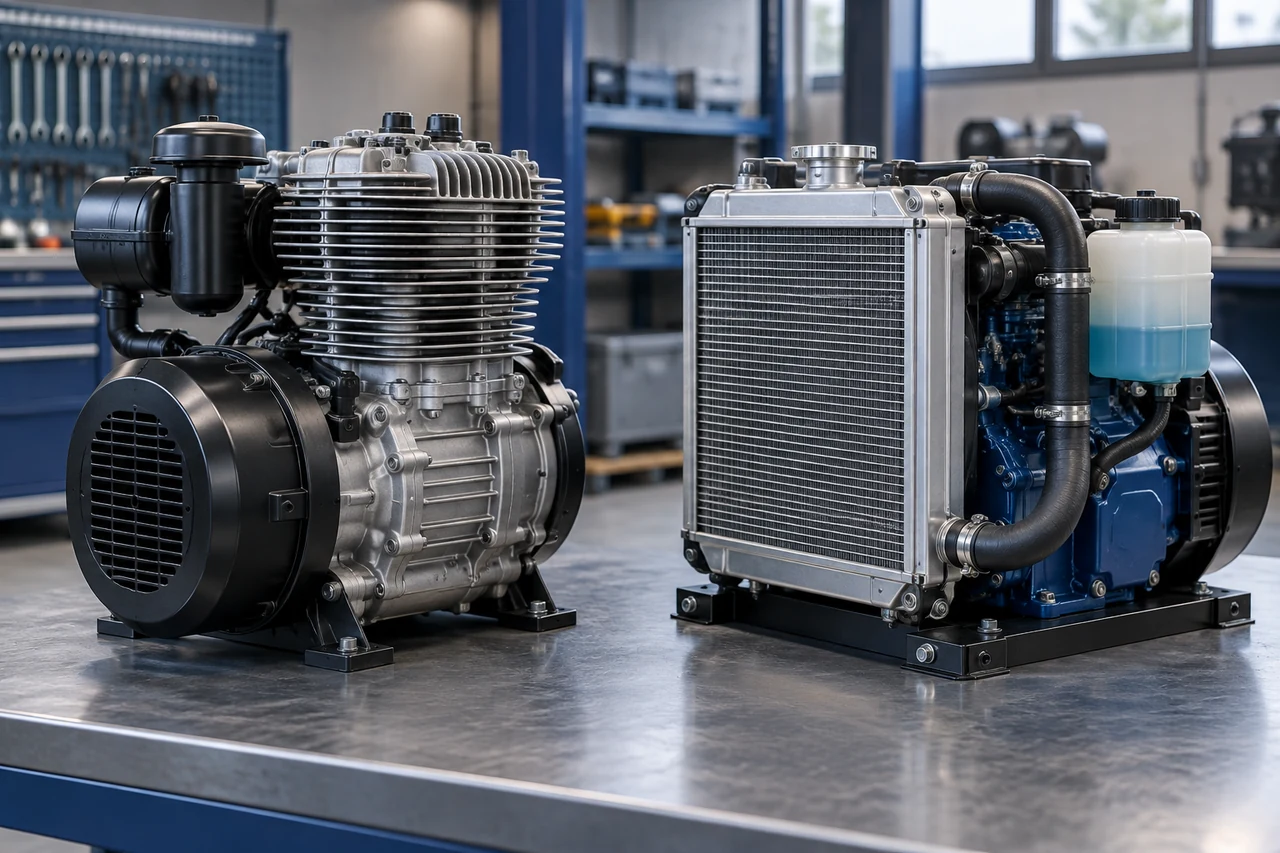
Air-cooled and water-cooled describe different ways a generator’s engine manages heat. The useful comparison is between specific models suitable for your load. Cooling type alone does not establish output, noise, lifespan or permission to run continuously.
Understand the cooling arrangement
An air-cooled engine transfers heat through its surfaces and cooling fins, with airflow provided by its designed cooling system. A water-cooled engine normally circulates specified coolant through the engine and rejects heat through a radiator or another designed heat exchanger.
Water-cooled does not usually mean the electrical alternator’s windings are cooled by water. In many diesel sets, the engine is liquid-cooled while the alternator uses air cooling. Check the actual equipment description before comparing packages.

Compare what the site must provide
Both arrangements need an unobstructed cooling-air path and a suitable exhaust system. Air-cooled equipment still needs the airflow specified for its engine and enclosure. A radiator-cooled set still releases heat to the surrounding installation through air passing across the radiator.
For a dusty work area, ask how cooling surfaces will be inspected and cleaned. For a site with freezing conditions, ask about the liquid-cooled engine’s specified coolant and cold-weather provisions. Do not assume either cooling type removes the need to consider ambient temperature or altitude.
Compare maintenance and operating data
Air cooling avoids a liquid coolant circuit, but it does not remove engine oil, filter, fuel or general inspection requirements. A liquid-cooled package adds checks for coolant condition, hoses and the radiator arrangement according to its manual.
Compare rated duty, starting performance, consumption and sound data for the proposed sets. Ask for the same test conditions where possible. One model’s enclosure or fan arrangement cannot support a general claim that every water-cooled set is quieter or every air-cooled set costs less to maintain.

Choose around your application
Describe the expected load, operating hours, available space and service arrangements when comparing NPC generator options. If the proposal uses liquid cooling, the water-cooled installation guide covers the next planning stage.
Ask NPC for a configuration comparison based on your site. The decision should follow documented model capabilities and installation requirements.