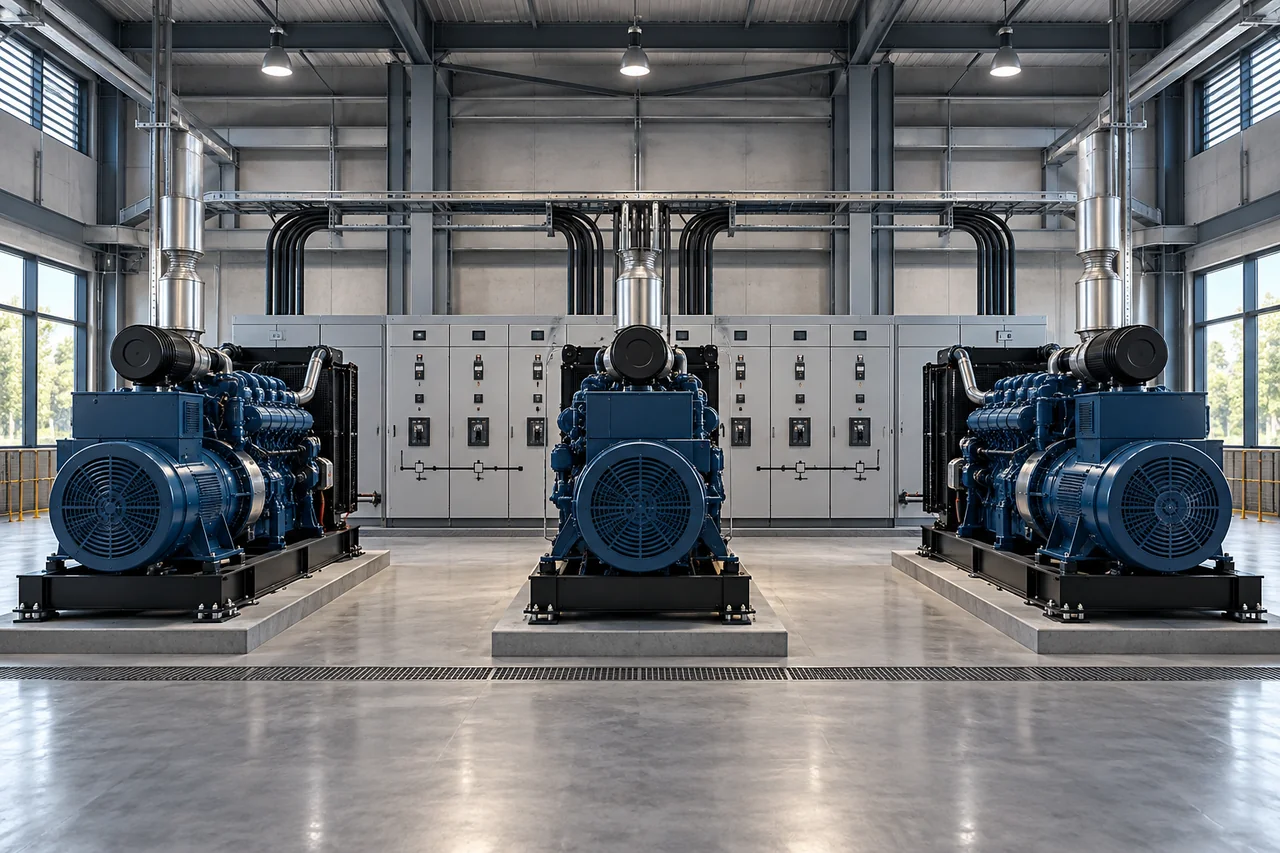
Generator paralleling allows suitably configured sets to supply a common electrical bus. It is an engineered system involving the generators, controls, switchgear and protection. An enquiry should define what the system must do before assuming that two available generator sets can operate together.
Define the operating purpose
Explain whether the project needs capacity growth, redundancy, improved loading or planned operation alongside the utility. Include the number of units, their ratings and whether new equipment must work with existing machines.
Describe normal demand, large starting loads, essential loads and the intended response when one set is unavailable. Utility-parallel operation also needs the appropriate utility review and site-specific protection requirements. Generator-to-generator operation does not automatically qualify a system for utility connection.
Specify synchronising and load sharing
Before connection, the system must verify compatible voltage, frequency, phase sequence and phase relationship within the engineered limits. Synchronising is only the connection stage. After connection, control of real and reactive power sharing is also required.
Ask the project team to confirm the compatibility of governors, voltage regulators, controllers and communications. Matching nameplate power alone is insufficient. The supplier must assess the actual engine, alternator and control versions, along with the switchgear arrangement.
Describe controls and protection
The specification should explain start sequencing, connection to an unenergised bus, load addition, load shedding and how units are removed from service. It should also define operator permissions, alarm handling and the response to equipment or communication failures.
Protection settings and breaker controls require coordinated engineering. Do not use generic online synchronising limits or attempt a trial connection by manually changing wiring or speed. Commissioning must follow the approved design and be performed by qualified personnel.
Prepare the project information
- Single-line diagram and utility/interface requirements.
- Existing and proposed generator model, rating and control details.
- Load list, starting sequence and permitted supply interruption.
- Required operating modes, redundancy objective and expansion plan.
- Acceptance tests, documentation and commissioning responsibilities.
For example, a two-set standby system and a multi-set prime-power plant may need different sequences even at similar total capacity. Review NPC generator configurations against the complete specification. Send NPC the project information so paralleling compatibility and the proposed scope can be assessed for the selected equipment.